

Pickleball Contractor Near Me: How to Choose in NC East
Pickleball Contractor Near Me: How to Choose the Right Court Builder in NC East
If you're looking for pickleball contractor near me, the best choice is a licensed, local court builder who handles site prep, base construction, surfacing, lines and fencing from start to finish. A true pickleball contractor in NC East understands our humidity, sandy soil and storm drainage, and builds to USA Pickleball construction guidance. Ace Coatings NC East does exactly that for homeowners in Wilmington and the surrounding communities.
What Does a Pickleball Contractor Actually Do?
A pickleball contractor designs and builds a court you can play on for years. Most homeowners expect "just paint on a slab." A proper court is a system, and each layer affects how the court plays and how long it lasts.
A full-service contractor typically handles:
- Site evaluation: checking slope, drainage, soil, shade and access for equipment.
- Base construction: a stable, properly graded concrete or asphalt foundation.
- Crack repair and preparation: fixing existing surfaces so problems don't telegraph through the new finish.
- Surfacing: multi-layer acrylic color coats that give consistent ball bounce and grip.
- Line striping: accurate, crisp court markings, including pickleball lines on an existing tennis or basketball court.
- Nets, posts and fencing: hardware sized and anchored correctly for the court.
If a company only does one of these steps, you may end up coordinating several crews. That's where delays and finger-pointing start.
How Much Space Do You Need for a Backyard Pickleball Court?
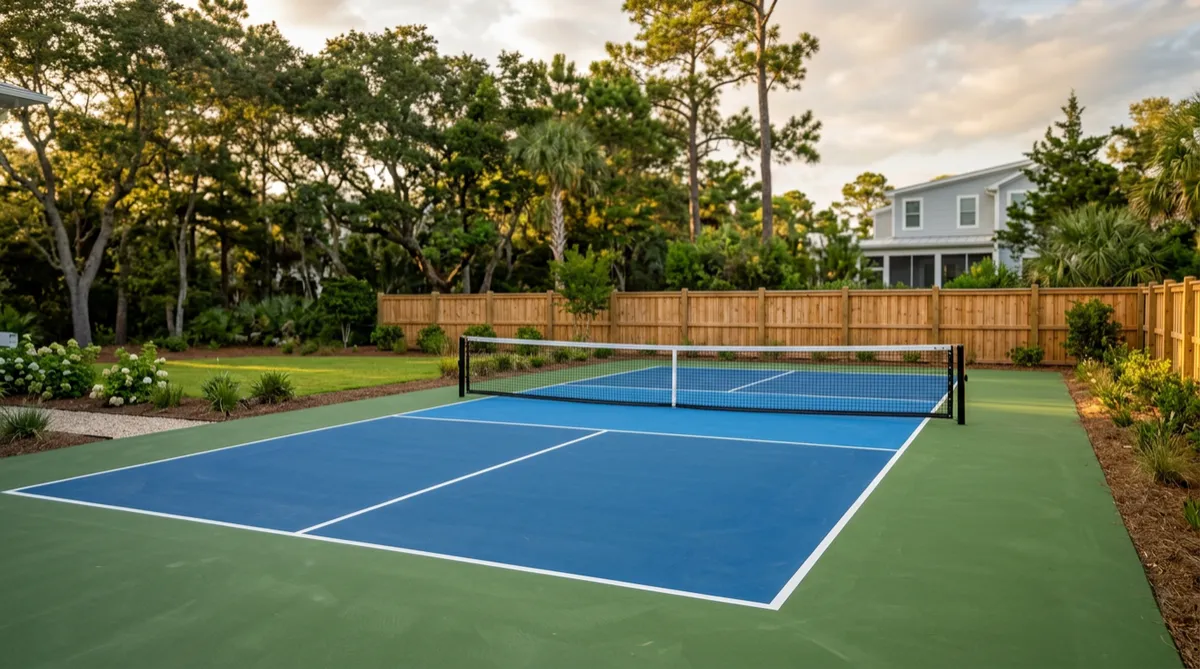
A pickleball court's playing area is 20 feet wide by 44 feet long. Most builders recommend a total footprint of about 30 by 60 feet so players have room to move behind the baselines and beside the sidelines. If your yard is tighter, a contractor can often suggest layouts or smaller recreational options, so measure first and ask before you rule it out.
Concrete vs. Asphalt: Which Base Is Better in Coastal North Carolina?
This is one of the most common questions homeowners ask.
| Factor | Concrete | Asphalt |
|---|---|---|
| Durability | Long-lasting with proper reinforcement and control joints | Durable, but can be more flexible with ground movement |
| Maintenance | Lower over time | Needs periodic resurfacing |
| Cracking | Can crack if poorly installed | Hairline cracks can form with age |
| Best for | Permanent home courts | Budget-conscious or existing paved areas |
For most residential courts, concrete is a popular, low-maintenance choice. The right answer depends on your soil, your drainage and your budget. A good contractor will walk the site before recommending either option.
What Makes Our Area Different for Court Construction?
Building in eastern North Carolina isn't the same as building in a dry, mild climate. Here's what a local pickleball contractor in NC East has to plan for:
- Humidity and moisture: Surfaces need proper drainage and curing conditions, or coatings can blister or peel.
- Heavy rain and storms: A correct slope keeps standing water off the court so you can play sooner after a downpour.
- Intense summer sun: UV-resistant color coatings help limit fading and surface wear.
- Sandy or shifting soil: The base must be prepared to reduce settling and cracking.
A contractor who works in this region every day already knows these conditions. That experience is worth more than a low quote from someone who doesn't.

How Is a Pickleball Court Built, Step by Step?
Knowing the process helps you spot a contractor who cuts corners. A well-run project usually follows this order:
- Consultation and site visit. You talk through your goals, space and budget.
- Layout and planning. The contractor marks the court footprint, checks drainage and confirms the orientation.
- Base preparation. The area is excavated, graded and compacted, then the concrete or asphalt base is placed.
- Curing time. The base needs adequate time to cure before surfacing begins. Rushing this step is a common cause of early failure.
- Surface preparation. The surface is cleaned, patched and leveled.
- Acrylic coating. Multiple layers are applied for texture, color and playability.
- Line painting. Court lines are measured and taped precisely, then painted.
- Net system and fencing. Posts, nets and any fencing are installed.
- Final walkthrough. You inspect the work and learn how to care for the court.
What Should You Ask Before Hiring a Pickleball Contractor?
Before you sign anything, ask these questions. A trustworthy contractor will answer them clearly.
- Are you licensed and insured to work in North Carolina?
- Can I see photos of courts you've built or resurfaced nearby?
- What materials and how many coating layers do you use?
- How do you handle drainage on my specific lot?
- Do you follow recognized construction guidance, such as USA Pickleball recommendations?
- What does your written estimate include, and what could change the price?
- What warranty or workmanship guarantee do you offer?
- What's the realistic timeline, including weather delays?
Watch out for vague answers, pressure to decide on the spot, and quotes that don't spell out the scope of work.
How Much Does a Pickleball Court Cost?
Costs vary widely. Your price depends on whether you need a brand-new base or only resurfacing, the size of the court, site access, drainage work, fencing, lighting and color choices. Converting an existing tennis or basketball court is usually less expensive than building from scratch.
The honest way to get a number is a site visit and a written estimate. Be cautious of any contractor who quotes a firm price without seeing your property.
Can You Convert an Existing Tennis or Basketball Court?
Yes, in many cases. If your current surface is in good structural condition, a contractor can repair cracks, apply a fresh color coat and add pickleball lines. You can create a dedicated pickleball court or a multi-use court with both sets of lines. This is often the quickest and most affordable way to start playing.
How Long Does a Pickleball Court Last, and How Do You Maintain It?
A well-built court can serve your family for many years. How long depends on the base, the coatings, the weather and how you care for it. A few habits go a long way:
- Sweep leaves and debris regularly.
- Wash the surface gently to keep algae and mildew from building up.
- Fill small cracks early before they spread.
- Plan to recoat the surface when color fades or the texture wears down.
- Keep sprinklers from soaking the court.

Why Homeowners Choose Ace Coatings NC East
Choosing a contractor is about trust. Homeowners in our area want a team that shows up, communicates clearly and stands behind the work. Ace Coatings NC East is a local team based in Wilmington, North Carolina, focused on surfaces that hold up to our climate.
Here's what you can expect when you work with us:
- A clear, written estimate with no surprises.
- Surface preparation that fits our humid, coastal conditions.
- Professional color coatings and accurate line striping.
- Honest advice on whether to build new or resurface what you have.
- Respect for your property and your schedule.
Whether you want a new backyard court for the family or want to turn an old slab into a pickleball court, we'll help you pick the right plan for your space and budget.
Frequently Asked Questions
What is the best pickleball contractor near me?
The best choice is a licensed, insured local contractor with proven court experience, a written estimate and a workmanship guarantee. Look for one who knows your area's soil, drainage and weather.
How long does it take to build a pickleball court?
A resurfacing project can take a few days, depending on weather. A new court takes longer because the base needs time to cure. Your contractor should give you a timeline after seeing your site.
Do I need a permit to build a backyard pickleball court?
Requirements depend on your city, county and HOA. Check local rules before you start, and ask your contractor what's needed for your property.
Can pickleball lines be added to my existing court?
Yes. If the surface is in good shape, lines can be added after any needed repairs and cleaning. A fresh color coat is often recommended at the same time.
Is a pickleball court a good investment for my home?
Many homeowners value a private court for the exercise, family time and entertaining. The return depends on your market and the quality of the build, so talk to a local real estate professional about resale impact.
Ready to Start Your Pickleball Court?
Don't settle for a rushed job or a vague quote. If you're looking for pickleball contractor near me, reach out to Ace Coatings NC East today. We'll visit your property, answer your questions and give you a straightforward plan for your new court.
